
When it comes to shopping for fresh produce, the freshness of the produce is the non-negotiable trait that every shopper looks for. Discount and pricing are the key factors for the customers - for discounter retail stores. However, product quality is key for the premium sector and price becomes secondary. To meet these expectations, the retail stores spend a great effort. Falling short of delivering freshness expectations not only disappoints customers but also leads to significant financial losses for businesses through spoilage and food waste.
So far, businesses in the retail sector, particularly in the food supply chain, have relied on manual and semi-manual methods such as manual inspection, basic logging of information, and subjective decisions to maintain product quality. These methods fall short as operational costs and increase large volumes of produce need to be handled.
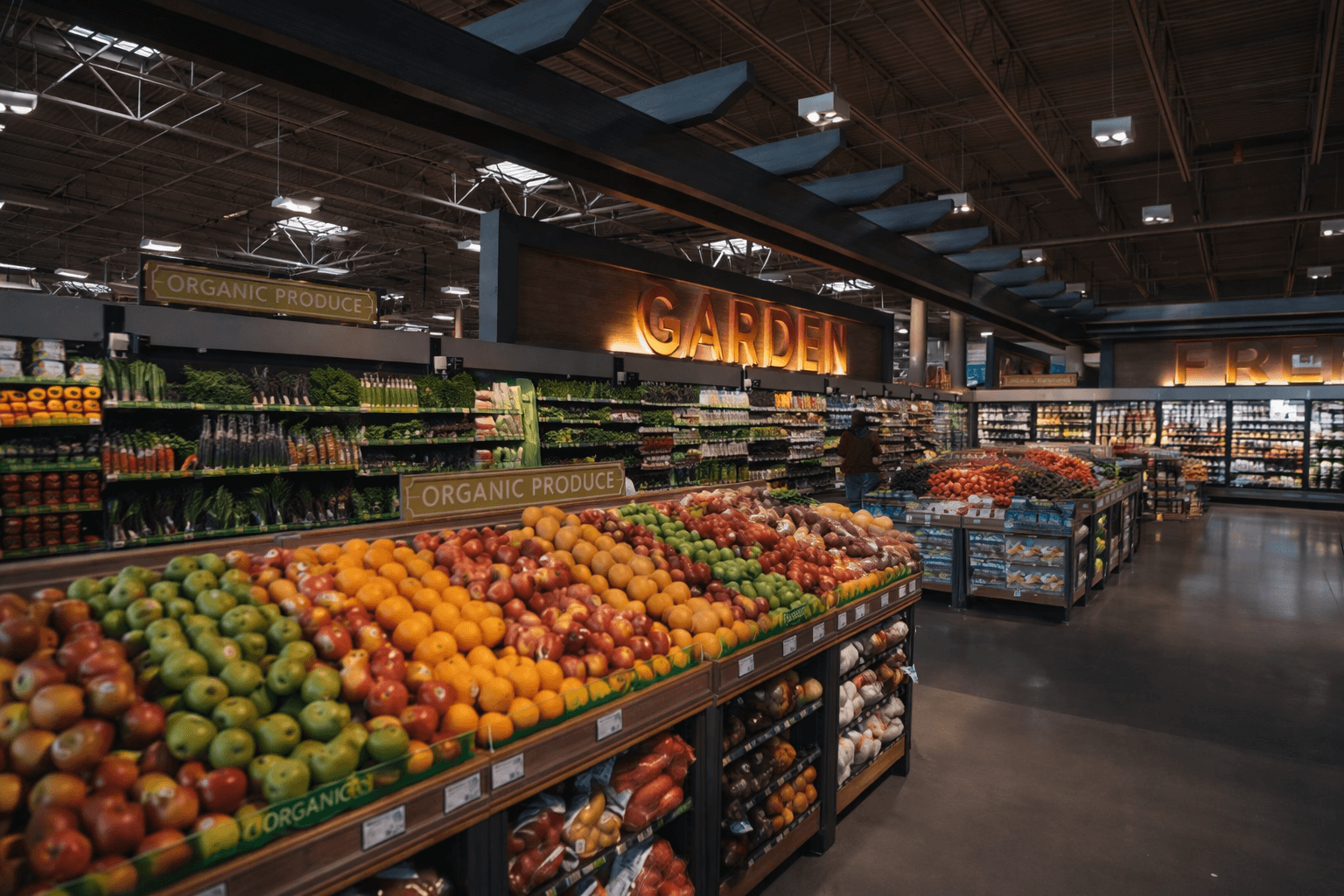
The legacy methods and systems create quality inconsistencies and operational blind spots. Variations in temperature, humidity, and air quality can affect freshness and reduce the shelf life of produce, leading to spoilage. This causes financial losses on one hand and a direct threat to brand reputation. For example, if a bakery chain must ensure that bread tastes the same every day in every store, from Bremen to Munich. Otherwise, this causes extra waste, unhappy customers who see bad products and service, which hurts brand name.
For businesses aiming to deliver consistent quality of products and services across multiple locations, standardizing and delivering quality produce is essential. Today, smart sensors collaborating with tomorrow's AI can help eliminate subjectivity in standardization, eliminate blind spots with real-time monitoring, and provide recommendations to keep produce at their highest freshness. Further, as we are now in 2026, EU regulations are tightening standards, and consumers are demanding more transparency and sustainability.
That led to fresh producers with long shelf life and happy customers & businesses
The businesses in the food supply chain, where precision, efficiency, and sustainability are not just buzzwords but vital for success and core values feel the pressure to deliver supreme quality and freshness. It is not just about reaching the best standards; maintaining them is even more important. Every day, trucks full of fresh fruits, veggies, cheese, meat, and bread are moved from one entity to another in the supply chain and finally made available to the end consumer. In this process of bringing fresh produce to the consumer, many things can go wrong.
For example, a supermarket operating storage and distribution facilities receives thousands of tonnes of fresh produce every hour. It gets checked and then stored or redistributed. Here, things can go wrong. Having basic sensors for temperature and humidity in the storage areas barely meets the requirements of rules like HACCP in Germany and the EU. However, when produce is not stored properly, freshness deteriorates gradually and then accelerates. Fruits and veggies ripen faster, releasing multiple gases, and weird smells appear in some areas. Remember the saying: “One bad fruit in the basket spoils all.” By the time you notice, it is already too late to act.
Further, operational and user behaviours can affect freshness and shelf life. For example, customers opening doors too many times in temperature-controlled areas may affect the shelf life of produce. Another example is infrastructure failure. A broken refrigerator can cause damage to the shelf life of the products. A real case scenario from our experience: the food supply chain loses nearly $560 billion every year. Fresh produce alone loses nearly $88 billion in supermarkets. If not controlled, waste from fresh items can be 10–15% or more.
In this regard, countries in the EU are pledging to reduce produce loss. For example, Germany is aiming to reduce it by 50% by the end of 2030 (in line with UN SDG 12.3).
Businesses are trying to commit to these goals, but without switching to better tools and improved operations, progress is not sustainable. Here, smart sensors and AI bridge the gap predicting spoilage, optimizing operations, and automating alerts which can dramatically improve shelf life and reduce waste. Adopting a more data-driven approach helps businesses bridge into the future.
Bridging to the future
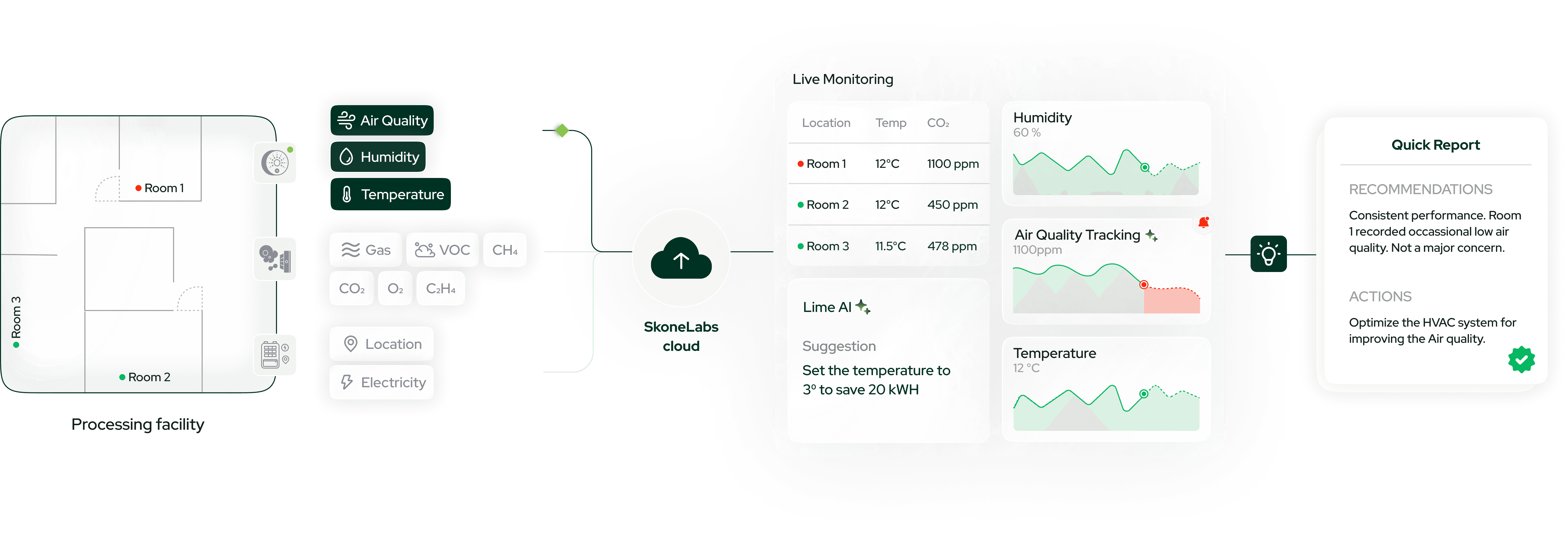
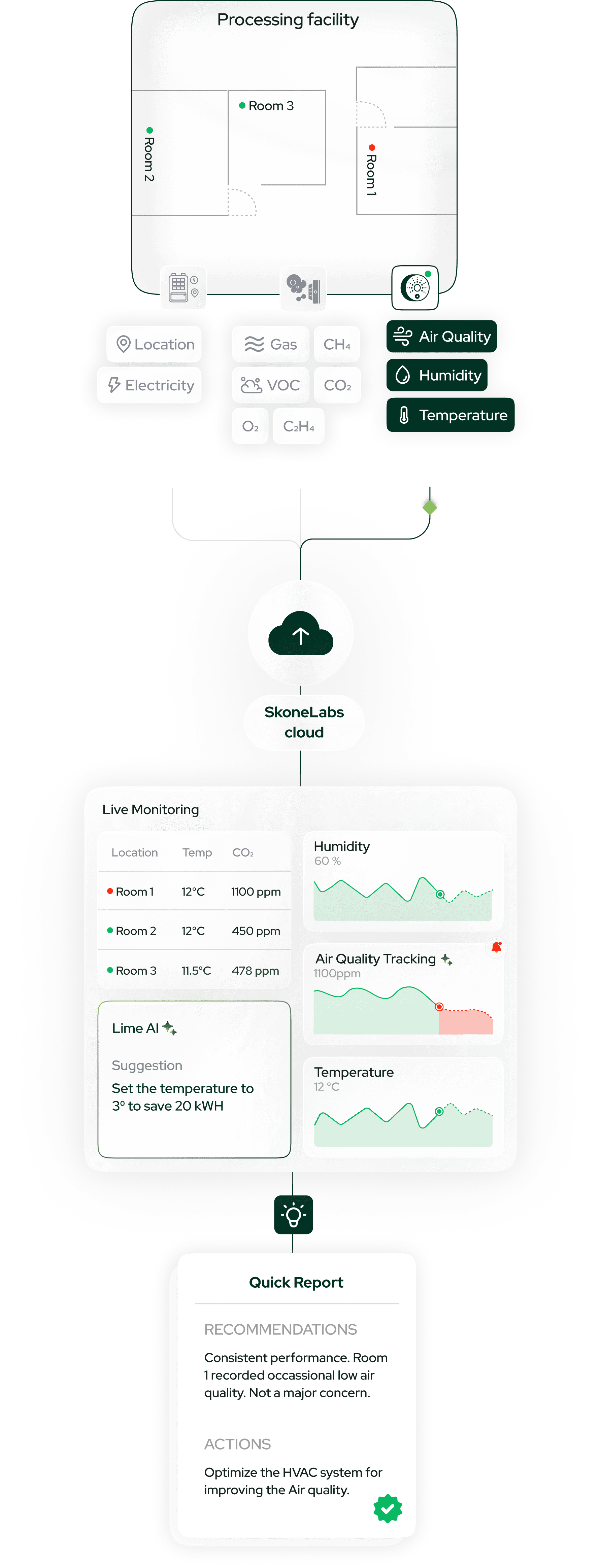
The transformation to data-driven freshness management is much simpler than it sounds, thanks to plug-and-play digital solutions, such as the SkoneLabs solution. Smart sensors can be deployed throughout facilities, monitoring not only temperature and humidity but also gas levels (ethylene and methane), air quality, and even the impacts of human activity. A human might not be able to observe a 1% increase in ethylene or a steady increase in the volatile organic compounds in the facility, but the smart sensors can pick up such small variations in the key parameters, acting as a digital nose. The digital nose can be active around the clock and help to identify the exact moment a single batch of produce begins to degrade, ahead of a human can spot the visible change.
These smart sensors feed live data into AI algorithms, which analyse the patterns, predict the risks of spoilage, and flag anomalies in no time. And no major changes and investment are needed for upgrading or the education of employees about AI solutions. The beauty of the system is in the ability to identify anomalies and deviations. By analysing millions of data points, the AI can find the "fingerprints" of anomalies, equipment failures, poor air circulation, operational differences, and human activity. For instance, when a facility closes in the evening and the HVAC system shifts to a lower power mode, the AI can detect poor air circulation that may lead to a spike in CO2 levels, damaging the freshness of leafy greens. Similarly, if a single batch of overripe or spoiled produce is accidentally stored with fresh stock area, the sensors identifies the sudden rise in ethylene concentration alerting the staff to remove the spoiled items before they trigger a "spoilage ripple reaction" across the entire fresh batch.
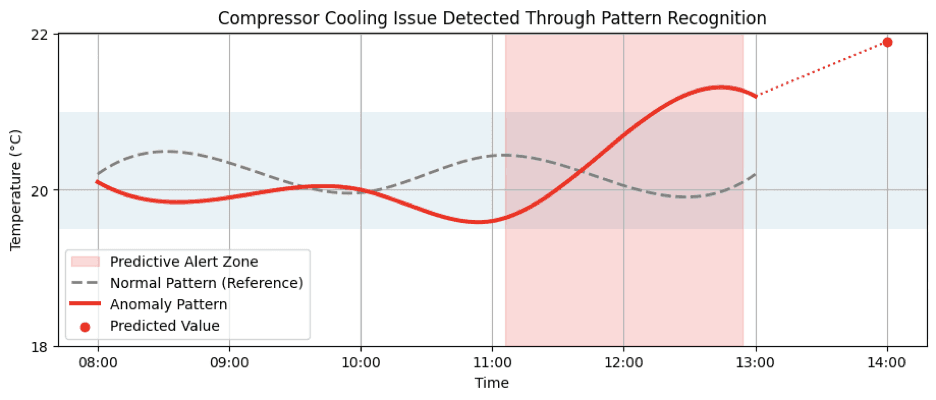
Further, the AI addition to smart sensors does not just report that it is getting warmer, it identifies specific patterns of temperature fluctuations, for example, due to compressor cooling issues and helps to fix them before the machine breaks. It can be the first step to predictive maintenance.
The combination of smart sensors and AI could recommend optimal storage spaces and layouts, for different categories of items, and can automate HVAC systems, based on data thresholds rather than subjective intuition. Quick predictive notifications would alert staff to act swiftly to stop a major issue before they occur, while periodic AI reports offer tailored optimizations, like better operation thresholds, potential equipment failure. Additionally, it should be noted that the implementation of AI technology in the industry would assist in creating standard procedures for all outlets.
The AI system can be trained not only to show what is happening now but to generate summary of future risks, which is done through pattern recognition. This can serve as a freshness forecast for quality managers to rearrange the stock in the retail store or the warehouse.
SkoneLabs is an example of this, providing quality monitoring and insights through AI in the retail and processing sectors. The initiatives increase product shelf life and boost profits by achieving the following:
Smart sensors for freshness monitoring: Real-time monitoring for environmental conditions to ensure best quality.
AI for data driven insights: Analytics that reveal operational deficiencies, predict wastage, and support decision making.
These technologies enable all outlets to achieve perfection through the removal of blind spots and quality inconsistencies. Looking ahead, smart sensors and AI will develop into predictive analytics for supply chain integration, further minimizing shrinkage. As a retailer bringing in the change for instance by organizing the warehouse differently or by using new technologies the payoffs will be much more significant: cost savings and sustainability. Shoppers see the immediate impact as well. In stores embracing these technologies, feedback glows: "Finally, produce that stays fresh longer, less waste at home!".
As a final note, the provided solution builds a bridge of trust between the consumer and the retailer. The future is here. In 2026, smart sensors and AI are not just an option; they are the logical next step toward regulatory excellence, waste reduction, and sustainable success. Solutions from SkoneLabs are ready: Simple and designed to bring greater value to customers.
" height="33.3717px" id="tQe3yOVLf" width="33.3717px"/><path d="M 13.169 15.614 L 15.91 8.083 C 16.004 7.826 16.051 7.697 16.045 7.564 C 16.039 7.431 15.981 7.307 15.866 7.059 L 15.866 7.059 L 13.03 0.978 C 12.765 0.41 12.633 0.127 12.374 0.031 C 12.116 -0.064 11.831 0.066 11.261 0.325 L 2.422 4.348 C 1.846 4.611 1.557 4.742 1.348 4.968 C 1.139 5.194 1.031 5.492 0.814 6.087 L 0.256 7.622 C 0.029 8.245 -0.085 8.557 0.074 8.703 C 0.233 8.849 0.534 8.709 1.135 8.428 L 9.144 4.694 C 10.015 4.287 10.451 4.084 10.848 4.229 C 11.245 4.373 11.448 4.809 11.855 5.681 L 12.471 7.002 C 12.684 7.46 12.791 7.689 12.802 7.934 C 12.813 8.18 12.726 8.417 12.553 8.892 L 11.211 12.581 C 10.994 13.177 10.886 13.475 10.676 13.701 C 10.467 13.927 10.178 14.058 9.601 14.321 L 5.28 16.284 L 4.914 16.455 L 2.283 17.695 C 1.686 17.976 1.387 18.117 1.397 18.332 C 1.407 18.547 1.717 18.66 2.337 18.886 L 4.611 19.713 C 4.873 19.809 5.004 19.856 5.139 19.85 C 5.274 19.843 5.4 19.782 5.651 19.661 L 12.493 16.362 C 12.735 16.245 12.856 16.187 12.944 16.09 C 13.032 15.993 13.078 15.866 13.169 15.614 Z" fill="rgb(140, 199, 79)" height="19.85013827632141px" id="GTqs4NUL_" stroke-dasharray="" stroke-linecap="butt" stroke-linejoin="miter" stroke-miterlimit="10" stroke-width="0.856289" stroke="rgb(140, 199, 79)" transform="translate(11.833 8.428)" width="16.0453935589273px"/><path d="M 2.872 4.245 L 0.137 11.759 C 0.042 12.02 -0.005 12.151 0 12.286 C 0.006 12.421 0.065 12.547 0.183 12.799 L 3.015 18.872 C 3.279 19.44 3.412 19.723 3.67 19.819 C 3.929 19.914 4.213 19.785 4.783 19.525 L 14.28 15.202 C 14.532 15.088 14.658 15.03 14.75 14.931 C 14.841 14.832 14.889 14.702 14.983 14.442 L 15.789 12.228 C 16.016 11.605 16.129 11.293 15.97 11.147 C 15.811 11.001 15.511 11.142 14.909 11.422 L 6.901 15.156 C 6.029 15.563 5.593 15.766 5.196 15.622 C 4.799 15.477 4.596 15.041 4.19 14.169 L 3.673 13.062 C 3.41 12.498 3.279 12.217 3.266 11.915 C 3.253 11.613 3.359 11.321 3.572 10.737 L 4.592 7.932 C 4.928 7.009 5.096 6.548 5.421 6.197 C 5.745 5.847 6.192 5.644 7.086 5.238 L 10.765 3.566 L 11.131 3.395 L 13.762 2.155 C 14.359 1.874 14.657 1.733 14.648 1.518 C 14.638 1.303 14.328 1.19 13.707 0.964 L 11.433 0.137 C 11.172 0.041 11.041 -0.006 10.906 0.001 C 10.77 0.007 10.645 0.068 10.394 0.189 L 10.394 0.189 L 3.559 3.485 C 3.314 3.603 3.191 3.662 3.101 3.761 C 3.012 3.86 2.966 3.988 2.872 4.245 Z" fill="rgb(140, 199, 79)" height="19.850146817561402px" id="MCGdfAMLm" stroke-dasharray="" stroke-linecap="butt" stroke-linejoin="miter" stroke-miterlimit="10" stroke-width="0.856289" stroke="rgb(140, 199, 79)" transform="translate(5.244 5.224)" width="16.044524713932457px"/><path d="M 0 13.237 L 4.088 13.293 C 4.227 15.184 5.729 16.491 8.12 16.491 C 10.039 16.491 11.458 15.657 11.458 14.127 C 11.458 12.487 9.872 12.153 6.619 11.513 C 3.337 10.901 0.445 9.845 0.445 5.896 C 0.445 2.447 3.309 0 7.703 0 C 12.292 0 15.212 2.392 15.267 6.118 L 11.179 6.118 C 10.985 4.477 9.733 3.337 7.703 3.337 C 5.923 3.337 4.644 4.088 4.644 5.59 C 4.644 7.175 6.174 7.509 9.4 8.12 C 12.737 8.732 15.685 9.733 15.657 13.655 C 15.629 17.298 12.626 19.801 8.065 19.801 C 3.115 19.801 0.028 17.186 0 13.237 Z" fill="rgb(0, 50, 35)" height="19.800539999999998px" id="HcKu9eCFc" transform="translate(41.987 6.631)" width="15.657095052213826px"/><path d="M 0 19.467 L 0 0 L 3.921 0 L 3.921 11.235 L 9.511 5.173 L 13.933 5.173 L 8.788 10.79 L 14.211 19.467 L 9.678 19.467 L 6.063 13.682 L 3.921 15.991 L 3.921 19.467 Z" fill="rgb(0, 50, 35)" height="19.46678px" id="W8s0sOKV1" transform="translate(59.006 6.798)" width="14.210799999999992px"/><path d="M 7.536 14.628 C 2.976 14.628 0 11.708 0 7.314 C 0 2.92 2.976 0 7.536 0 C 12.097 0 15.073 2.92 15.073 7.314 C 15.073 11.736 12.097 14.628 7.536 14.628 Z M 7.536 11.43 C 9.733 11.43 11.096 9.733 11.096 7.314 C 11.096 4.895 9.733 3.198 7.536 3.198 C 5.34 3.198 4.005 4.895 4.005 7.314 C 4.005 9.733 5.34 11.43 7.536 11.43 Z" fill="rgb(0, 50, 35)" height="14.6279px" id="kKFD6aOHW" transform="translate(72.064 11.803)" width="15.072900000000004px"/><path d="M 8.204 0 C 11.291 0 13.932 1.641 13.932 6.535 L 13.932 14.461 L 10.011 14.461 L 10.011 6.925 C 10.011 4.505 9.094 3.226 7.119 3.226 C 5.089 3.226 3.921 4.672 3.921 7.147 L 3.921 14.461 L 0 14.461 L 0 0.167 L 3.421 0.167 L 3.782 1.947 C 4.7 0.834 6.007 0 8.204 0 Z" fill="rgb(0, 50, 35)" height="14.461000000000002px" id="uuxq5g5Nd" transform="translate(88.461 11.803)" width="13.932400000000001px"/><path d="M 7.62 14.628 C 2.865 14.628 0 11.764 0 7.342 C 0 2.892 2.92 0 7.342 0 C 11.625 0 14.517 2.67 14.572 6.869 C 14.572 7.286 14.545 7.759 14.461 8.204 L 4.088 8.204 L 4.088 8.399 C 4.172 10.429 5.479 11.652 7.453 11.652 C 9.038 11.652 10.151 10.957 10.484 9.622 L 14.35 9.622 C 13.905 12.403 11.43 14.628 7.62 14.628 Z M 4.172 5.645 L 10.624 5.645 C 10.345 3.893 9.15 2.92 7.37 2.92 C 5.673 2.92 4.394 3.949 4.172 5.645 Z" fill="rgb(0, 50, 35)" height="14.6279px" id="dz6S4fVHs" transform="translate(103.419 11.803)" width="14.572000000000003px"/><path d="M 11.903 19.467 L 0 19.467 L 0 0 L 4.171 0 L 4.171 15.879 L 11.903 15.879 Z" fill="rgb(0, 50, 35)" height="19.46678px" id="Ocy6ENq6_" transform="translate(119.606 6.798)" width="11.902999999999992px"/><path d="M 14.183 11.152 L 14.628 11.152 L 14.628 14.461 L 12.626 14.461 C 10.596 14.461 9.956 13.488 9.984 12.125 C 8.983 13.71 7.537 14.628 5.312 14.628 C 2.225 14.628 0 13.154 0 10.429 C 0 7.397 2.28 5.673 6.563 5.673 L 9.4 5.673 L 9.4 4.978 C 9.4 3.699 8.482 2.864 6.841 2.864 C 5.312 2.864 4.283 3.56 4.116 4.616 L 0.334 4.616 C 0.612 1.835 3.17 0 6.953 0 C 10.957 0 13.265 1.78 13.265 5.2 L 13.265 10.262 C 13.265 11.013 13.571 11.152 14.183 11.152 Z M 9.4 8.565 L 9.4 8.287 L 6.535 8.287 C 4.895 8.287 3.949 8.955 3.949 10.151 C 3.949 11.152 4.756 11.791 6.063 11.791 C 8.121 11.791 9.372 10.512 9.4 8.565 Z" fill="rgb(0, 50, 35)" height="14.6279px" id="qlYjE7kXf" transform="translate(131.923 11.803)" width="14.627999999999986px"/><path d="M 8.231 5.006 C 12.069 5.006 14.85 7.759 14.85 12.292 C 14.85 16.714 12.069 19.634 8.204 19.634 C 6.146 19.634 4.727 18.744 3.81 17.52 L 3.42 19.467 L 0 19.467 L 0 0 L 3.921 0 L 3.921 6.98 C 4.866 5.84 6.257 5.006 8.231 5.006 Z M 7.341 16.436 C 9.483 16.436 10.873 14.767 10.873 12.32 C 10.873 9.872 9.483 8.204 7.341 8.204 C 5.2 8.204 3.865 9.872 3.865 12.292 C 3.865 14.739 5.2 16.436 7.341 16.436 Z" fill="rgb(0, 50, 35)" height="19.63368px" id="MkjXdi4_z" transform="translate(147.234 6.798)" width="14.849999999999994px"/><path d="M 0 9.734 L 3.727 9.734 C 3.866 10.985 4.95 11.847 6.869 11.847 C 8.51 11.847 9.511 11.319 9.511 10.318 C 9.511 9.15 8.538 9.066 6.23 8.76 C 2.893 8.371 0.306 7.62 0.306 4.672 C 0.306 1.836 2.781 -0.027 6.452 0 C 10.29 0 12.932 1.697 13.127 4.617 L 9.372 4.617 C 9.261 3.477 8.176 2.781 6.591 2.781 C 5.062 2.781 4.061 3.337 4.061 4.255 C 4.061 5.34 5.284 5.451 7.342 5.701 C 10.624 6.035 13.349 6.786 13.349 10.012 C 13.349 12.848 10.679 14.656 6.842 14.656 C 2.865 14.656 0.167 12.793 0 9.734 Z" fill="rgb(0, 50, 35)" height="14.656006885775646px" id="Z66WXo71v" transform="translate(162.651 11.775)" width="13.34899999999999px"/></svg>)